
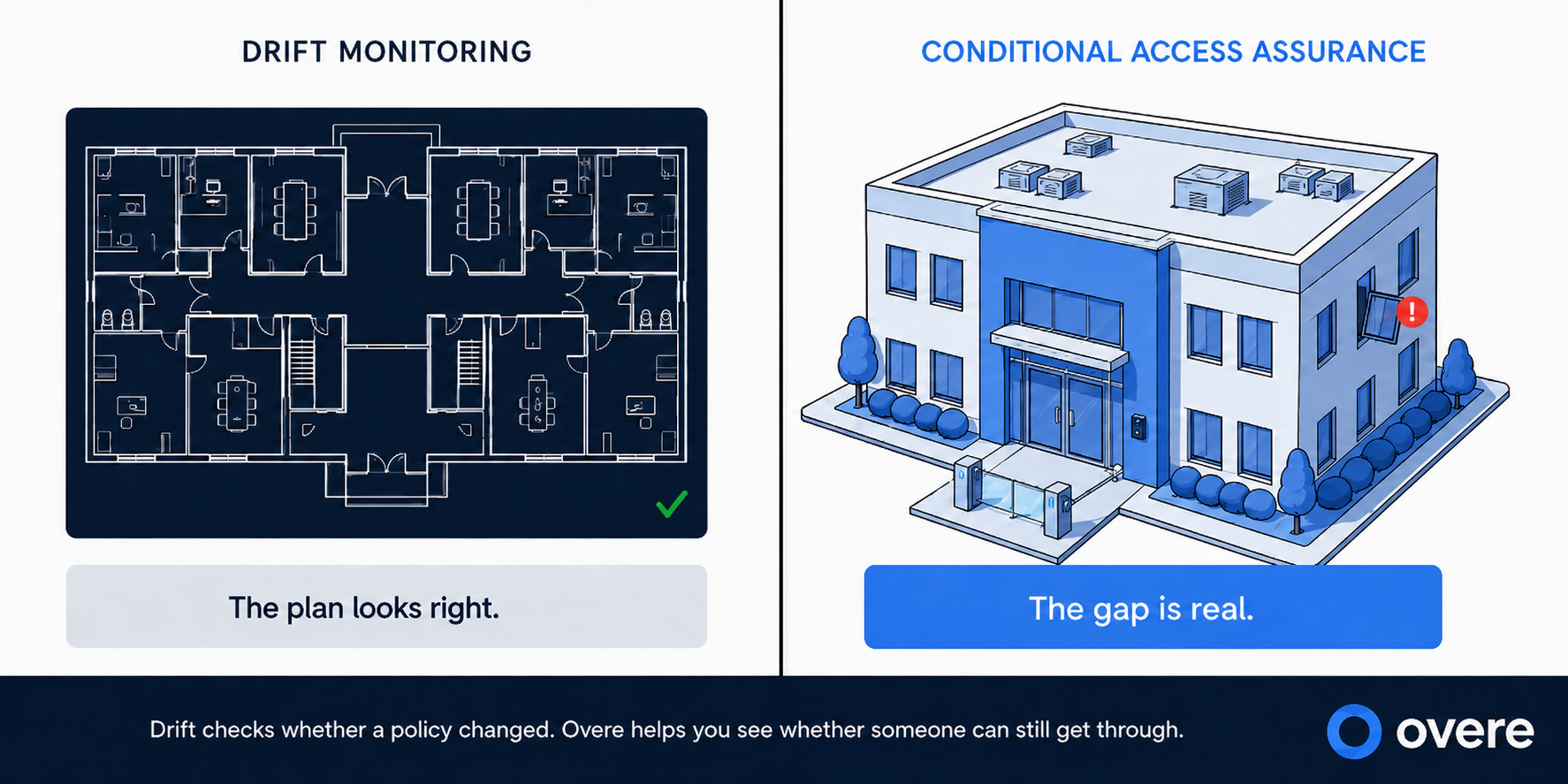
Inforcer monitors Conditional Access baseline drift.
CIPP helps MSPs review, standardise and remediate Conditional Access configuration across tenants.
Augmentt watches for policy drift, alerts when something changes, and lets you roll back to a known version.
SaaS Alerts monitors deviations from a desired security baseline and corrects them across tenants.
All of that has value.
But none of those descriptions answers the question that matters most:
When a user, device, application or service account attempts to sign in, does Conditional Access actually enforce the protection we intended?
That is not a configuration question. It is an assurance question.
Drift monitoring asks a relatively narrow question: has the Conditional Access policy changed from a known baseline?
That matters. A policy change can introduce risk, undo a hardening decision or create inconsistency across customers.
But a policy can remain exactly as configured, match the approved baseline, pass a drift check, and still leave an access path outside the protection the business believes is in place.
Nothing has drifted. But there is still a gap.
Conditional Access policies are not standalone settings. They are evaluated together across users, groups, applications, devices, locations, risk levels, session controls, exclusions and grant requirements.
Over time, most environments accumulate policies for different user types, group exclusions, trusted locations, legacy authentication exceptions, privileged accounts, emergency access accounts, device conditions and application-specific rules.
Each of those may be valid in isolation. The problem comes from how they interact.
An MFA policy can look correctly configured but fail to apply to a subset of users. A privileged account may be excluded for a legitimate reason but have no alternative control in place. A trusted location may create an intended bypass that nobody has validated. An application may sit outside every policy that was meant to protect it.
The policy itself has not changed. But the exposure is real.
Most Conditional Access tooling in the market sits across three distinct layers.
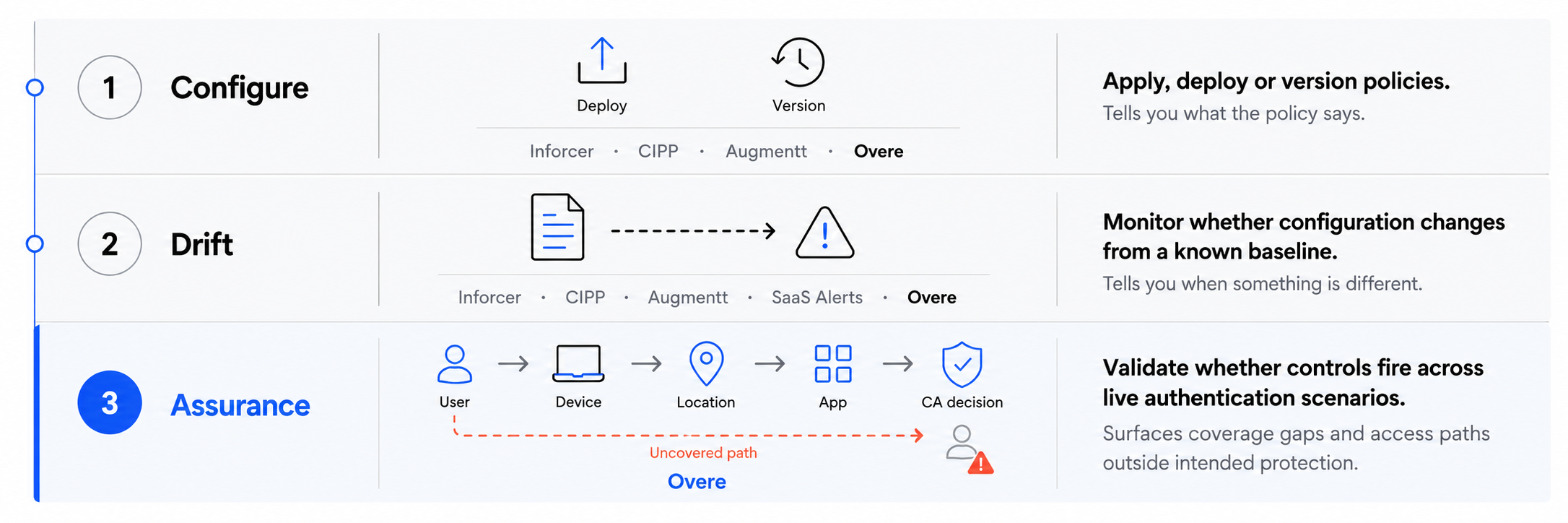
Configure. Tools at this layer help you apply, deploy, version, back up or restore Conditional Access policies. They tell you what the policy says.
Drift. Tools at this layer monitor whether that policy configuration changes from a known baseline. They tell you when something is different.
Assurance. This is where Conditional Access Assurance operates. It validates whether Conditional Access controls fire as intended across live authentication scenarios, surfacing coverage gaps, excluded subjects and access paths that fall outside intended protection.
The first two layers protect the policy document. Only the third answers whether the protection actually applies.
The Conditional Access tooling market is well developed around configuration and drift. Policy deployment, baseline standardisation, change detection, rollback. These are legitimate, valuable capabilities and most MSPs who take Conditional Access seriously are already running at least one of these tools.
But they share a common boundary. They answer one question: does the Conditional Access configuration match the intended policy baseline?
Overe Conditional Access Assurance asks a different question: does Conditional Access actually apply the intended protection across live authentication events?
A managed IT provider running a customer tenant of around 200 users had a Conditional Access policy requiring MFA for all cloud apps. The policy was enabled, applied to all users, and showed no drift. On paper, coverage looked complete.
Conditional Access Assurance found an exclusion group originally created for a migration project 14 months earlier that had never been reviewed. It started as two break-glass accounts. By the time of the scan it contained 15 members, including three Global Administrators added during a subsequent IT project and never removed.
Every member of that group could access all cloud apps, including the Microsoft 365 admin centre and SharePoint, without any MFA requirement. The policy was correctly written. The exclusion rendered it irrelevant for the highest-privilege accounts in the tenant.
Nothing had drifted. No alert had fired. The gap had been there for over a year.
Once visible, the fix was straightforward: the Global Administrator accounts were removed from the exclusion group and membership was flagged for quarterly review. The MSP had a specific finding, a specific action, and a clear record to show the customer the issue had been closed.
For an MSP, the challenge is not just creating good Conditional Access policies once. It is proving that protection remains effective across every customer tenant as each environment evolves.
That means being able to quickly identify which users are not covered by MFA or stronger sign-in controls, which privileged accounts have unexpected access paths, which service accounts and legacy authentication routes bypass protection, which guest or external access scenarios fall outside intended coverage, and which approved exceptions are understood versus unknown gaps nobody realised existed.
In a multi-tenant environment, manually interpreting Conditional Access logic across every customer is slow, difficult and highly dependent on specialist knowledge. Drift monitoring does not close that gap. It was not designed to.
"Drift alerts are useful, but they only tell you something changed. What matters to us is knowing whether a customer is still protected when someone actually tries to sign in.
Paul Burgwin, IT Director, ITConsec
A drift is a configuration change — the difference between the policy you had yesterday and the one you have now. A gap is something different: an access path where the intended protection does not apply, whether because of how policies interact, who is excluded, or what has never been in scope.
The two can be related. A policy change can create a gap. But an unchanged policy can carry a gap that has existed for months without a single drift alert ever firing.
That distinction matters for how you think about your tooling. Drift monitoring is built to detect and reverse configuration changes. Conditional Access Assurance is built to answer whether the protection is actually working — regardless of whether anything changed.
Drift checks whether a policy changed. Overe helps you see whether someone can still get through.
Overe Conditional Access Assurance gives MSPs continuous visibility into Conditional Access coverage, enforcement and exposure across Microsoft 365.
It is not another drift monitor. It is not a baseline comparison tool. It validates whether the Conditional Access controls you have configured are actually delivering the protection outcome you expect.
When a gap is found, Overe does not just surface it. Each finding comes with a specific remediation recommendation scoped to the actual tenant context. When the fix is in place, you have the evidence to show a client their environment is protected, not just configured.
Start a 14-day full product trial -- full platform access on a live customer site, no commitment beyond 14 days. See the enforcement gaps in a real tenant, not a demo environment.
Or book a Conditional Access Assurance walkthrough if you want to see it in action first.