How-to...

Reveal Hidden Conditional Access Gaps Before Attackers Do

Most organisations believe Conditional Access is enforcing what they intended.

In reality, hidden authentication paths, policy overlaps, exclusions, legacy access routes, and mis-scoped conditions often leave users able to sign in without the protections security teams think are enforced.

Traditional validation methods simply cannot keep up with the complexity of modern Microsoft 365 environments.
Credit card mockups

Manual reviews are slow and error-prone

Conditional Access changes constantly.

New users, devices, apps, locations, exclusions, and policy updates can silently introduce risky authentication paths long after a review has been completed.

By the time a manual assessment is finished, parts of it are already outdated.

Microsoft What-If only shows part of the picture

Testing one scenario at a time does not reveal how Conditional Access behaves across the entire tenant.

Most hidden gaps emerge from the combined effect of multiple policies, exclusions, conditions, and edge cases interacting together.

Attackers only need one unintended path.

Report-only mode delays real validation

Waiting for users to naturally trigger authentication flows leaves security teams blind to unknown exposures.

Critical gaps can remain undiscovered for weeks or months simply because the right sign-in combination has not yet occurred.

Consulting reports do not provide ongoing assurance

Traditional assessments provide a snapshot in time.

They rarely deliver continuous validation that protections remain enforced as environments evolve, policies drift, and operational changes occur

Overe Conditional Access Assurance (CAA)

Validate how Conditional Access actually behaves across your entire tenant

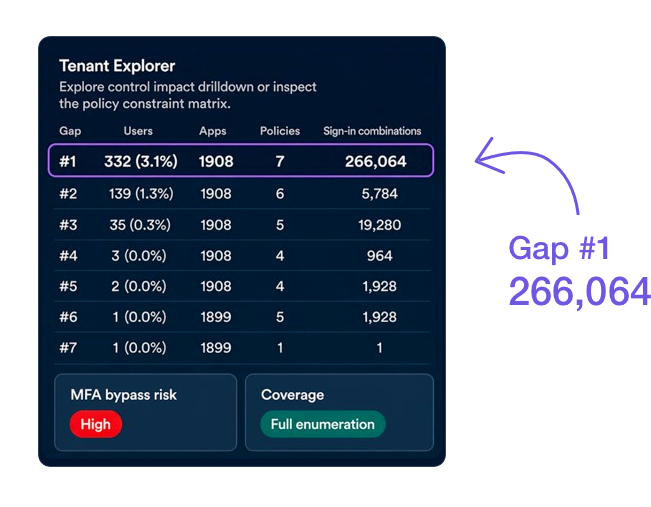
Overe Conditional Access Assurance continuously analyses authentication paths across users, applications, devices, locations, client types, risks, and policy combinations to identify where protections are not being enforced as intended.

Instead of testing isolated scenarios, Overe reveals real-world exposure paths in seconds.

Discover hidden authentication paths

Surface risky sign-in routes, MFA bypass opportunities, legacy authentication exposure, policy conflicts, and unintended access combinations automatically.

Simulate policy changes instantly

Model Conditional Access behaviour before deployment without relying on report-only mode or impacting production users.
Understand exactly what a policy change will enforce before rollout.

Patch gaps with confidence

Turn findings into guided remediation workflows so teams can rapidly close exposures and strengthen enforcement across the tenant.
Credit card mockups
Current Approaches
Overe company logo with circular blue gradient icon and white text on transparent background.
Current Approaches
Manual policy reviews
Overe company logo with circular blue gradient icon and white text on transparent background.
Automated tenant-wide analysis
Current Approaches
One scenario at a time
Overe company logo with circular blue gradient icon and white text on transparent background.
Full authentication path enumeration
Current Approaches
Point-in-time assessments
Overe company logo with circular blue gradient icon and white text on transparent background.
Continuous assurance
Current Approaches
Report-only dependency
Overe company logo with circular blue gradient icon and white text on transparent background.
Instant simulation
Current Approaches
Static consultant reports
Overe company logo with circular blue gradient icon and white text on transparent background.
Operational remediation guidance
Current Approaches
Reactive discovery
Overe company logo with circular blue gradient icon and white text on transparent background.
Proactive exposure identification

Know where your Conditional Access gaps really are

See how attackers could still authenticate into your environment despite existing policies and controls.

Discover hidden access paths in seconds, not weeks.